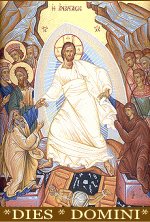
Showing posts with label Sunday the Lords Day. Show all posts

Dies Domini - Keeping the Lords Day Holy - Parts 81 - 83 - Pope John Paul II

CONCLUSION

81. The spiritual and pastoral riches of Sunday, as it has been handed on to us by tradition, are truly great. When its significance and implications are understood in their entirety, Sunday in a way becomes a synthesis of the Christian life and a condition for living it well. It is clear therefore why the observance of the Lord's Day is so close to the Church's heart, and why in the Church's discipline it remains a real obligation. Yet more than as a precept, the observance should be seen as a need rising from the depths of Christian life. It is crucially important that all the faithful should be convinced that they cannot live their faith or share fully in the life of the Christian community unless they take part regularly in the Sunday Eucharistic assembly. The Eucharist is the full realization of the worship which humanity owes to God, and it cannot be compared to any other religious experience. A particularly efficacious expression of this is the Sunday gathering of the entire community, obedient to the voice of the Risen Lord who calls the faithful together to give them the light of his word and the nourishment of his Body as the perennial sacramental wellspring of redemption. The grace flowing from this wellspring renews mankind, life and history.

82. It is with this strong conviction of faith, and with awareness of the heritage of human values which the observance of Sunday entails, that Christians today must face the enticements of a culture which has accepted the benefits of rest and free time, but which often uses them frivolously and is at times attracted by morally questionable forms of entertainment. Certainly, Christians are no different from other people in enjoying the weekly day of rest; but at the same time they are keenly aware of the uniqueness and originality of Sunday, the day on which they are called to celebrate their salvation and the salvation of all humanity. Sunday is the day of joy and the day of rest precisely because it is "the Lord's Day", the day of the Risen Lord.

83. Understood and lived in this fashion, Sunday in a way becomes the soul of the other days, and in this sense we can recall the insight of Origen that the perfect Christian "is always in the Lord's Day, and is always celebrating Sunday". (131) Sunday is a true school, an enduring programme of Church pedagogy — an irreplaceable pedagogy, especially with social conditions now marked more and more by a fragmentation and cultural pluralism which constantly test the faithfulness of individual Christians to the practical demands of their faith. In many parts of the world, we see a "diaspora" Christianity, which is put to the test because the scattered disciples of Christ can no longer easily maintain contact with one another, and lack the support of the structures and traditions proper to Christian culture. In a situation of such difficulty, the opportunity to come together on Sundays with fellow believers, exchanging gifts of brother- hood, is an indispensable help.

Dies Domini - Parts 74 - 75 - Pope John Paul II

CHAPTER V

DIES DIERUM
Sunday: the Primordial Feast,
Revealing the Meaning of Time


Christ the Alpha and Omega of time


74. "In Christianity time has a fundamental importance. Within the dimension of time the world was created; within it the history of salvation unfolds, finding its culmination in the 'fullness of time' of the Incarnation, and its goal in the glorious return of the Son of God at the end of time. In Jesus Christ, the Word made flesh, time becomes a dimension of God, who is himself eternal". (118)

In the light of the New Testament, the years of Christ's earthly life truly constitute the centre of time; this centre reaches its apex in the Resurrection. It is true that Jesus is God made man from the very moment of his conception in the womb of the Blessed Virgin, but only in the Resurrection is his humanity wholly transfigured and glorified, thus revealing the fullness of his divine identity and glory. In his speech in the synagogue at Antioch in Pisidia (cf. Acts 13:33), Paul applies the words of Psalm 2 to the Resurrection of Christ: "You are my Son, this day I have begotten you" (v. 7). It is precisely for this reason that, in celebrating the Easter Vigil, the Church acclaims the Risen Christ as "the Beginning and End, the Alpha and Omega". These are the words spoken by the celebrant as he prepares the Paschal candle, which bears the number of the current year. These words clearly attest that "Christ is the Lord of time; he is its beginning and its end; every year, every day and every moment are embraced by his Incarnation and Resurrection, and thus become part of the 'fullness of time'". (119)

75. Since Sunday is the weekly Easter, recalling and making present the day upon which Christ rose from the dead, it is also the day which reveals the meaning of time. It has nothing in common with the cosmic cycles according to which natural religion and human culture tend to impose a structure on time, succumbing perhaps to the myth of eternal return. The Christian Sunday is wholly other! Springing from the Resurrection, it cuts through human time, the months, the years, the centuries, like a directional arrow which points them towards their target: Christ's Second Coming. Sunday foreshadows the last day, the day of the Parousia, which in a way is already anticipated by Christ's glory in the event of the Resurrection.

In fact, everything that will happen until the end of the world will be no more than an extension and unfolding of what happened on the day when the battered body of the Crucified Lord was raised by the power of the Spirit and became in turn the wellspring of the Spirit for all humanity. Christians know that there is no need to wait for another time of salvation, since, however long the world may last, they are already living in the last times. Not only the Church, but the cosmos itself and history are ceaselessly ruled and governed by the glorified Christ. It is this life-force which propels creation, "groaning in birth-pangs until now" (Rom 8:22), towards the goal of its full redemption. Mankind can have only a faint intuition of this process, but Christians have the key and the certainty. Keeping Sunday holy is the important witness which they are called to bear, so that every stage of human history will be upheld by hope.

Dies Domini - Parts 57 & 58 - Pope John Paul II

57. Therefore, if we wish to rediscover the full meaning of Sunday, we must rediscover this aspect of the life of faith. Certainly, Christian joy must mark the whole of life, and not just one day of the week. But in virtue of its significance as the day of the Risen Lord, celebrating God's work of creation and "new creation", Sunday is the day of joy in a very special way, indeed the day most suitable for learning how to rejoice and to rediscover the true nature and deep roots of joy. This joy should never be confused with shallow feelings of satisfaction and pleasure, which inebriate the senses and emotions for a brief moment, but then leave the heart unfulfilled and perhaps even embittered. In the Christian view, joy is much more enduring and consoling; as the saints attest, it can hold firm even in the dark night of suffering. (103) It is, in a certain sense, a "virtue" to be nurtured.


58. Yet there is no conflict whatever between Christian joy and true human joys, which in fact are exalted and find their ultimate foundation precisely in the joy of the glorified Christ, the perfect image and revelation of man as God intended. As my revered predecessor Paul VI wrote in his Exhortation on Christian joy: "In essence, Christian joy is a sharing in the unfathomable joy, at once divine and human, found in the heart of the glorified Christ". (104) Pope Paul concluded his Exhortation by asking that, on the Lord's Day, the Church should witness powerfully to the joy experienced by the Apostles when they saw the Lord on the evening of Easter.

To this end, he urged pastors to insist "upon the need for the baptized to celebrate the Sunday Eucharist in joy. How could they neglect this encounter, this banquet which Christ prepares for us in his love? May our sharing in it be most worthy and joyful! It is Christ, crucified and glorified, who comes among his disciples, to lead them all together into the newness of his Resurrection. This is the climax, here below, of the covenant of love between God and his people: the sign and source of Christian joy, a stage on the way to the eternal feast". (105) This vision of faith shows the Christian Sunday to be a true "time for celebration", a day given by God to men and women for their full human and spiritual growth.

Dies Domini - Keeping the Lords Day Holy - Part 45 - Pope John Paul II

From Mass to "mission"


45. Receiving the Bread of Life, the disciples of Christ ready themselves to undertake with the strength of the Risen Lord and his Spirit the tasks which await them in their ordinary life. For the faithful who have understood the meaning of what they have done, the Eucharistic celebration does not stop at the church door. Like the first witnesses of the Resurrection, Christians who gather each Sunday to experience and proclaim the presence of the Risen Lord are called to evangelize and bear witness in their daily lives. Given this, the Prayer after Communion and the Concluding Rite — the Final Blessing and the Dismissal — need to be better valued and appreciated, so that all who have shared in the Eucharist may come to a deeper sense of the responsibility which is entrusted to them.
 
Once the assembly disperses, Christ's disciples return to their everyday surroundings with the commitment to make their whole life a gift, a spiritual sacrifice pleasing to God (cf. Rom 12:1). They feel indebted to their brothers and sisters because of what they have received in the celebration, not unlike the disciples of Emmaus who, once they had recognized the Risen Christ "in the breaking of the bread" (cf. Lk 24:30-32), felt the need to return immediately to share with their brothers and sisters the joy of meeting the Lord (cf. Lk 24:33-35).

Dies Domini - Part 44. Keeping the Lords Day Holy - Pope John Paul II

Easter banquet and fraternal gathering


44. The communal character of the Eucharist emerges in a special way when it is seen as the Easter banquet, in which Christ himself becomes our nourishment. In fact, "for this purpose Christ entrusted to the Church this sacrifice: so that the faithful might share in it, both spiritually, in faith and charity, and sacramentally, in the banquet of Holy Communion. Sharing in the Lord's Supper is always communion with Christ, who offers himself for us in sacrifice to the Father".(72) This is why the Church recommends that the faithful receive communion when they take part in the Eucharist, provided that they are properly disposed and, if aware of grave sin, have received God's pardon in the Sacrament of Reconciliation,(73) in the spirit of what Saint Paul writes to the community at Corinth (cf. 1 Cor 11:27-32). Obviously, the invitation to Eucharistic communion is more insistent in the case of Mass on Sundays and holy days.

It is also important to be ever mindful that communion with Christ is deeply tied to communion with our brothers and sisters. The Sunday Eucharistic gathering is an experience of brotherhood, which the celebration should demonstrate clearly, while ever respecting the nature of the liturgical action. All this will be helped by gestures of welcome and by the tone of prayer, alert to the needs of all in the community. The sign of peace — in the Roman Rite significantly placed before Eucharistic communion — is a particularly expressive gesture which the faithful are invited to make as a manifestation of the People of God's acceptance of all that has been accomplished in the celebration(74) and of the commitment to mutual love which is made in sharing the one bread, with the demanding words of Christ in mind: "If you are offering your gift at the altar, and there remember that your brother has something against you, leave your gift there before the altar and go; first be reconciled with your brother, and then come and offer your gift" (Mt 5:23-24).

Dies Domini - Keeping the Lords Day Holy - Parts 26 - 27 - Pope John Paul II

The eighth day: image of eternity


26. By contrast, the Sabbath's position as the seventh day of the week suggests for the Lord's Day a complementary symbolism, much loved by the Fathers. Sunday is not only the first day, it is also "the eighth day", set within the sevenfold succession of days in a unique and transcendent position which evokes not only the beginning of time but also its end in "the age to come". Saint Basil explains that Sunday symbolizes that truly singular day which will follow the present time, the day without end which will know neither evening nor morning, the imperishable age which will never grow old; Sunday is the ceaseless foretelling of life without end which renews the hope of Christians and encourages them on their way.(26) Looking towards the last day, which fulfils completely the eschatological symbolism of the Sabbath, Saint Augustine concludes the Confessions describing the Eschaton as "the peace of quietness, the peace of the Sabbath, a peace with no evening".(27) In celebrating Sunday, both the "first" and the "eighth" day, the Christian is led towards the goal of eternal life.(28)

The day of Christ-Light

27. This Christocentric vision sheds light upon another symbolism which Christian reflection and pastoral practice ascribed to the Lord's Day. Wise pastoral intuition suggested to the Church the christianization of the notion of Sunday as "the day of the sun", which was the Roman name for the day and which is retained in some modern languages.(29) This was in order to draw the faithful away from the seduction of cults which worshipped the sun, and to direct the celebration of the day to Christ, humanity's true "sun". Writing to the pagans, Saint Justin uses the language of the time to note that Christians gather together "on the day named after the sun",(30) but for believers the expression had already assumed a new meaning which was unmistakeably rooted in the Gospel.(31) Christ is the light of the world (cf. Jn 9:5; also 1:4-5, 9), and, in the weekly reckoning of time, the day commemorating his Resurrection is the enduring reflection of the epiphany of his glory.

The theme of Sunday as the day illuminated by the triumph of the Risen Christ is also found in the Liturgy of the Hours(32) and is given special emphasis in the Pannichida, the vigil which in the Eastern liturgies prepares for Sunday. From generation to generation as she gathers on this day, the Church makes her own the wonderment of Zechariah as he looked upon Christ, seeing in him the dawn which gives "light to those who sit in darkness and in the shadow of death" (Lk 1:78-79), and she echoes the joy of Simeon when he takes in his arms the divine Child who has come as the "light to enlighten the Gentiles" (Lk 2:32).

Dies Domini - Part 23 - Pope John Paul II

Growing distinction from the Sabbath

23. It was this newness which the catechesis of the first centuries stressed as it sought to show the prominence of Sunday relative to the Jewish Sabbath. It was on the Sabbath that the Jewish people had to gather in the synagogue and to rest in the way prescribed by the Law. The Apostles, and in particular Saint Paul, continued initially to attend the synagogue so that there they might proclaim Jesus Christ, commenting upon "the words of the prophets which are read every Sabbath" (Acts 13:27). Some communities observed the Sabbath while also celebrating Sunday. Soon, however, the two days began to be distinguished ever more clearly, in reaction chiefly to the insistence of those Christians whose origins in Judaism made them inclined to maintain the obligation of the old Law.

Saint Ignatius of Antioch writes: "If those who were living in the former state of things have come to a new hope, no longer observing the Sabbath but keeping the Lord's Day, the day on which our life has appeared through him and his death ..., that mystery from which we have received our faith and in which we persevere in order to be judged disciples of Christ, our only Master, how could we then live without him, given that the prophets too, as his disciples in the Spirit, awaited him as master?".(21) Saint Augustine notes in turn: "Therefore the Lord too has placed his seal on his day, which is the third after the Passion. In the weekly cycle, however, it is the eighth day after the seventh, that is after the Sabbath, and the first day of the week".(22) The distinction of Sunday from the Jewish Sabbath grew ever stronger in the mind of the Church, even though there have been times in history when, because the obligation of Sunday rest was so emphasized, the Lord's Day tended to become more like the Sabbath. Moreover, there have always been groups within Christianity which observe both the Sabbath and Sunday as "two brother days".(23)

Dies Domini - Keeping the Lords Day Holy - Parts 20 - 22. - Pope John Paul II

20. According to the common witness of the Gospels, the Resurrection of Jesus Christ from the dead took place on "the first day after the Sabbath" (Mk 16:2,9; Lk 24:1; Jn 20:1). On the same day, the Risen Lord appeared to the two disciples of Emmaus (cf. Lk 24:13-35) and to the eleven Apostles gathered together (cf. Lk 24:36; Jn 20:19). A week later — as the Gospel of John recounts (cf. 20:26) — the disciples were gathered together once again, when Jesus appeared to them and made himself known to Thomas by showing him the signs of his Passion. The day of Pentecost — the first day of the eighth week after the Jewish Passover (cf. Acts 2:1), when the promise made by Jesus to the Apostles after the Resurrection was fulfilled by the outpouring of the Holy Spirit (cf. Lk 24:49; Acts 1:4-5) — also fell on a Sunday. This was the day of the first proclamation and the first baptisms: Peter announced to the assembled crowd that Christ was risen and "those who received his word were baptized" (Acts 2:41). This was the epiphany of the Church, revealed as the people into which are gathered in unity, beyond all their differences, the scattered children of God.

The first day of the week

21. It was for this reason that, from Apostolic times, "the first day after the Sabbath", the first day of the week, began to shape the rhythm of life for Christ's disciples (cf. 1 Cor 16:2). "The first day after the Sabbath" was also the day upon which the faithful of Troas were gathered "for the breaking of bread", when Paul bade them farewell and miraculously restored the young Eutychus to life (cf. Acts 20:7-12). The Book of Revelation gives evidence of the practice of calling the first day of the week "the Lord's Day" (1:10). This would now be a characteristic distinguishing Christians from the world around them. As early as the beginning of the second century, it was noted by Pliny the Younger, governor of Bithynia, in his report on the Christian practice "of gathering together on a set day before sunrise and singing among themselves a hymn to Christ as to a god".(19) And when Christians spoke of the "Lord's Day", they did so giving to this term the full sense of the Easter proclamation: "Jesus Christ is Lord" (Phil 2:11; cf. Acts 2:36; 1 Cor 12:3). Thus Christ was given the same title which the Septuagint used to translate what in the revelation of the Old Testament was the unutterable name of God: YHWH.

22. In those early Christian times, the weekly rhythm of days was generally not part of life in the regions where the Gospel spread, and the festive days of the Greek and Roman calendars did not coincide with the Christian Sunday. For Christians, therefore, it was very difficult to observe the Lord's Day on a set day each week. This explains why the faithful had to gather before sunrise.(20) Yet fidelity to the weekly rhythm became the norm, since it was based upon the New Testament and was tied to Old Testament revelation. This is eagerly underscored by the Apologists and the Fathers of the Church in their writings and preaching where, in speaking of the Paschal Mystery, they use the same Scriptural texts which, according to the witness of Saint Luke (cf. 24:27, 44-47), the Risen Christ himself would have explained to the disciples. In the light of these texts, the celebration of the day of the Resurrection acquired a doctrinal and symbolic value capable of expressing the entire Christian mystery in all its newness.

Dies Domini - Keeping the Lords Day Holy - Part 19. - Pope John Paul II

CHAPTER II

DIES CHRISTI

The Day of the Risen Lord

and of the Gift

of the Holy Spirit

The weekly Easter

19. "We celebrate Sunday because of the venerable Resurrection of our Lord Jesus Christ, and we do so not only at Easter but also at each turning of the week": so wrote Pope Innocent I at the beginning of the fifth century,(15) testifying to an already well established practice which had evolved from the early years after the Lord's Resurrection. Saint Basil speaks of "holy Sunday, honoured by the Lord's Resurrection, the first fruits of all the other days";(16) and Saint Augustine calls Sunday "a sacrament of Easter".(17)

The intimate bond between Sunday and the Resurrection of the Lord is strongly emphasized by all the Churches of East and West. In the tradition of the Eastern Churches in particular, every Sunday is the anastàsimos hemèra, the day of Resurrection,(18) and this is why it stands at the heart of all worship.

In the light of this constant and universal tradition, it is clear that, although the Lord's Day is rooted in the very work of creation and even more in the mystery of the biblical "rest" of God, it is nonetheless to the Resurrection of Christ that we must look in order to understand fully the Lord's Day. This is what the Christian Sunday does, leading the faithful each week to ponder and live the event of Easter, true source of the world's salvation.

Dies Domini - Keeping the Lords Day Holy - Part 18 - Pope John Paul II

From the Sabbath to Sunday

18. Because the Third Commandment depends upon the remembrance of God's saving works and because Christians saw the definitive time inaugurated by Christ as a new beginning, they made the first day after the Sabbath a festive day, for that was the day on which the Lord rose from the dead. The Paschal Mystery of Christ is the full revelation of the mystery of the world's origin, the climax of the history of salvation and the anticipation of the eschatological fulfilment of the world. What God accomplished in Creation and wrought for his People in the Exodus has found its fullest expression in Christ's Death and Resurrection, though its definitive fulfilment will not come until the Parousia, when Christ returns in glory.

In him, the "spiritual" meaning of the Sabbath is fully realized, as Saint Gregory the Great declares: "For us, the true Sabbath is the person of our Redeemer, our Lord Jesus Christ".(14) This is why the joy with which God, on humanity's first Sabbath, contemplates all that was created from nothing, is now expressed in the joy with which Christ, on Easter Sunday, appeared to his disciples, bringing the gift of peace and the gift of the Spirit (cf. Jn 20:19-23). It was in the Paschal Mystery that humanity, and with it the whole creation, "groaning in birth-pangs until now" (Rom 8:22), came to know its new "exodus" into the freedom of God's children who can cry out with Christ, "Abba, Father!" (Rom 8:15; Gal 4:6). In the light of this mystery, the meaning of the Old Testament precept concerning the Lord's Day is recovered, perfected and fully revealed in the glory which shines on the face of the Risen Christ (cf. 2 Cor 4:6). We move from the "Sabbath" to the "first day after the Sabbath", from the seventh day to the first day: the dies Domini becomes the dies Christi!

Dies Domini - Keeping the Lords Day Holy Parts 16 & 17 - Pope John Paul II

To "keep holy" by "remembering"


16. The commandment of the Decalogue by which God decrees the Sabbath observance is formulated in the Book of Exodus in a distinctive way: "Remember the Sabbath day in order to keep it holy" (20:8). And the inspired text goes on to give the reason for this, recalling as it does the work of God: "For in six days the Lord made heaven and earth, the sea, and all that is in them, and rested on the seventh day; therefore the Lord blessed the Sabbath day and made it holy" (v. 11). Before decreeing that something be done, the commandment urges that something be remembered. It is a call to awaken remembrance of the grand and fundamental work of God which is creation, a remembrance which must inspire the entire religious life of man and then fill the day on which man is called to rest. Rest therefore acquires a sacred value: the faithful are called to rest not only as God rested, but to rest in the Lord, bringing the entire creation to him, in praise and thanksgiving, intimate as a child and friendly as a spouse.

17. The connection between Sabbath rest and the theme of "remembering" God's wonders is found also in the Book of Deuteronomy (5:12-15), where the precept is grounded less in the work of creation than in the work of liberation accomplished by God in the Exodus: "You shall remember that you were a slave in the land of Egypt, and the Lord your God brought you out from there with mighty hand and outstretched arm; therefore the Lord your God commanded you to keep the Sabbath day" (Dt 5:15).

This formulation complements the one we have already seen; and taken together, the two reveal the meaning of "the Lord's Day" within a single theological vision which fuses creation and salvation. Therefore, the main point of the precept is not just any kind of interruption of work, but the celebration of the marvels which God has wrought.

Insofar as this "remembrance" is alive, full of thanksgiving and of the praise of God, human rest on the Lord's Day takes on its full meaning. It is then that man enters the depths of God's "rest" and can experience a tremor of the Creator's joy when, after the creation, he saw that all he had made "was very good" (Gn 1:31).

Dies Domini Parts 14 & 15 - Pope John Paul II

14. In the first place, therefore, Sunday is the day of rest because it is the day "blessed" by God and "made holy" by him, set apart from the other days to be, among all of them, "the Lord's Day".


In order to grasp fully what the first of the biblical creation accounts means by keeping the Sabbath "holy", we need to consider the whole story, which shows clearly how every reality, without exception, must be referred back to God. Time and space belong to him. He is not the God of one day alone, but the God of all the days of humanity.

Therefore, if God "sanctifies" the seventh day with a special blessing and makes it "his day" par excellence, this must be understood within the deep dynamic of the dialogue of the Covenant, indeed the dialogue of "marriage". This is the dialogue of love which knows no interruption, yet is never monotonous. In fact, it employs the different registers of love, from the ordinary and indirect to those more intense, which the words of Scripture and the witness of so many mystics do not hesitate to describe in imagery drawn from the experience of married love.

15. All human life, and therefore all human time, must become praise of the Creator and thanksgiving to him. But man's relationship with God also demands times of explicit prayer, in which the relationship becomes an intense dialogue, involving every dimension of the person. "The Lord's Day" is the day of this relationship par excellence when men and women raise their song to God and become the voice of all creation.

This is precisely why it is also the day of rest. Speaking vividly as it does of "renewal" and "detachment", the interruption of the often oppressive rhythm of work expresses the dependence of man and the cosmos upon God. Everything belongs to God! The Lord's Day returns again and again to declare this principle within the weekly reckoning of time. The "Sabbath" has therefore been interpreted evocatively as a determining element in the kind of "sacred architecture" of time which marks biblical revelation.(13) It recalls that the universe and history belong to God; and without a constant awareness of that truth, man cannot serve in the world as co-worker of the Creator.

Dies Domini - Keeping the Lords Day Holy Part 12 - Pope John Paul II

12. In the Creator's plan, there is both a distinction and a close link between the order of creation and the order of salvation. This is emphasized in the Old Testament, when it links the "shabbat" commandment not only with God's mysterious "rest" after the days of creation (cf. Ex 20:8-11), but also with the salvation which he offers to Israel in the liberation from the slavery of Egypt (cf. Dt 5:12-15). The God who rests on the seventh day, rejoicing in his creation, is the same God who reveals his glory in liberating his children from Pharaoh's oppression. Adopting an image dear to the Prophets, one could say that in both cases God reveals himself as the bridegroom before the bride (cf. Hos 2:16-24; Jer 2:2; Is 54:4-8).


As certain elements of the same Jewish tradition suggest,(12) to reach the heart of the "shabbat", of God's "rest", we need to recognize in both the Old and the New Testament the nuptial intensity which marks the relationship between God and his people. Hosea, for instance, puts it thus in this marvellous passage: "I will make for you a covenant on that day with the beasts of the field, the birds of the air, and the creeping things of the ground; and I will abolish the bow, the sword, and war from the land; and I will make you lie down in safety. And I will betroth you to me for ever; I will betroth you to me in righteousness and in justice, in steadfast love and in mercy. I will betroth you to me in faithfulness; and you shall know the Lord" (2:18-20).

Dies Domini - Keeping the Lords Day Holy Part 11 - Pope John Paul II

"Shabbat": the Creator's joyful rest


11. If the first page of the Book of Genesis presents God's "work" as an example for man, the same is true of God's "rest": "On the seventh day God finished his work which he had done" (Gn 2:2). Here too we find an anthropomorphism charged with a wealth of meaning.

It would be banal to interpret God's "rest" as a kind of divine "inactivity". By its nature, the creative act which founds the world is unceasing and God is always at work, as Jesus himself declares in speaking of the Sabbath precept: "My Father is working still, and I am working" (Jn 5:17). The divine rest of the seventh day does not allude to an inactive God, but emphasizes the fullness of what has been accomplished. It speaks, as it were, of God's lingering before the "very good" work (Gn 1:31) which his hand has wrought, in order to cast upon it a gaze full of joyous delight.

This is a "contemplative" gaze which does not look to new accomplishments but enjoys the beauty of what has already been achieved. It is a gaze which God casts upon all things, but in a special way upon man, the crown of creation. It is a gaze which already discloses something of the nuptial shape of the relationship which God wants to establish with the creature made in his own image, by calling that creature to enter a pact of love. This is what God will gradually accomplish, in offering salvation to all humanity through the saving covenant made with Israel and fulfilled in Christ. It will be the Word Incarnate, through the eschatological gift of the Holy Spirit and the configuration of the Church as his Body and Bride, who will extend to all humanity the offer of mercy and the call of the Father's love.

Dies Domini (Keeping the Lords Day Holy) Parts 9 & 10 - Pope Benedict XVI

"In the beginning, God created the heavens and the earth" (Gn 1:1)


9. The poetic style of the Genesis story conveys well the awe which people feel before the immensity of creation and the resulting sense of adoration of the One who brought all things into being from nothing. It is a story of intense religious significance, a hymn to the Creator of the universe, pointing to him as the only Lord in the face of recurring temptations to divinize the world itself. At the same time, it is a hymn to the goodness of creation, all fashioned by the mighty and merciful hand of God.

"God saw that it was good" (Gn 1:10,12, etc.). Punctuating the story as it does, this refrain sheds a positive light upon every element of the universe and reveals the secret for a proper understanding of it and for its eventual regeneration: the world is good insofar as it remains tied to its origin and, after being disfigured by sin, it is again made good when, with the help of grace, it returns to the One who made it. It is clear that this process directly concerns not inanimate objects and animals but human beings, who have been endowed with the incomparable gift and risk of freedom. Immediately after the creation stories, the Bible highlights the dramatic contrast between the grandeur of man, created in the image and likeness of God, and the fall of man, which unleashes on the world the darkness of sin and death (cf. Gn 3).

10. Coming as it does from the hand of God, the cosmos bears the imprint of his goodness. It is a beautiful world, rightly moving us to admiration and delight, but also calling for cultivation and development. At the "completion" of God's work, the world is ready for human activity. "On the seventh day God finished his work which he had done, and he rested on the seventh day from all his work which he had done" (Gn 2:2). With this anthropomorphic image of God's "work", the Bible not only gives us a glimpse of the mysterious relationship between the Creator and the created world, but also casts light upon the task of human beings in relation to the cosmos.

The "work" of God is in some ways an example for man, called not only to inhabit the cosmos, but also to "build" it and thus become God's "co-worker". As I wrote in my Encyclical Laborem Exercens, the first chapters of Genesis constitute in a sense the first "gospel of work".(10) This is a truth which the Second Vatican Council also stressed: "Created in God's image, man was commissioned to subdue the earth and all it contains, to rule the world in justice and holiness, and, recognizing God as the creator of all things, to refer himself and the totality of things to God so that with everything subject to God, the divine name would be glorified in all the earth".(11)

The exhilarating advance of science, technology and culture in their various forms — an ever more rapid and today even overwhelming development — is the historical consequence of the mission by which God entrusts to man and woman the task and responsibility of filling the earth and subduing it by means of their work, in the observance of God's Law.

Dies Domini Part 8 - (Keeping the Lord's Day Holy) - Pope John Paul II

CHAPTER I

DIES DOMINI

The Celebration of the Creator's Work

"Through him all things were made" (Jn 1:3)

8. For the Christian, Sunday is above all an Easter celebration, wholly illumined by the glory of the Risen Christ. It is the festival of the "new creation". Yet, when understood in depth, this aspect is inseparable from what the first pages of Scripture tell us of the plan of God in the creation of the world. It is true that the Word was made flesh in "the fullness of time" (Gal 4:4); but it is also true that, in virtue of the mystery of his identity as the eternal Son of the Father, he is the origin and end of the universe. As John writes in the Prologue of his Gospel: "Through him all things were made, and without him was made nothing that was made" (1:3). Paul too stresses this in writing to the Colossians: "In him all things were created, in heaven and on earth, visible and invisible .... All things were created through him and for him" (1:16).

This active presence of the Son in the creative work of God is revealed fully in the Paschal Mystery, in which Christ, rising as "the first fruits of those who had fallen asleep" (1 Cor 15:20), established the new creation and began the process which he himself will bring to completion when he returns in glory to "deliver the kingdom to God the Father ..., so that God may be everything to everyone" (1 Cor 15:24,28).

Already at the dawn of creation, therefore, the plan of God implied Christ's "cosmic mission". This Christocentric perspective, embracing the whole arc of time, filled God's well-pleased gaze when, ceasing from all his work, he "blessed the seventh day and made it holy" (Gn 2:3). According to the Priestly writer of the first biblical creation story, then was born the "Sabbath", so characteristic of the first Covenant, and which in some ways foretells the sacred day of the new and final Covenant. The theme of "God's rest" (cf. Gn 2:2) and the rest which he offered to the people of the Exodus when they entered the Promised Land (cf. Ex 33:14; Dt 3:20; 12:9; Jos 21:44; Ps 95:11) is re-read in the New Testament in the light of the definitive "Sabbath rest" (Heb 4:9) into which Christ himself has entered by his Resurrection. The People of God are called to enter into this same rest by persevering in Christ's example of filial obedience (cf. Heb 4:3-16). In order to grasp fully the meaning of Sunday, therefore, we must re-read the great story of creation and deepen our understanding of the theology of the "Sabbath".

Dies Domini - Keeping the Lords Day Holy Parts 5 - 7 - Pope John Paul II

5. From this perspective, the situation appears somewhat mixed. On the one hand, there is the example of some young Churches, which show how fervently Sunday can be celebrated, whether in urban areas or in widely scattered villages. By contrast, in other parts of the world, because of the sociological pressures already noted, and perhaps because the motivation of faith is weak, the percentage of those attending the Sunday liturgy is strikingly low. In the minds of many of the faithful, not only the sense of the centrality of the Eucharist but even the sense of the duty to give thanks to the Lord and to pray to him with others in the community of the Church, seems to be diminishing.

It is also true that both in mission countries and in countries evangelized long ago the lack of priests is such that the celebration of the Sunday Eucharist cannot always be guaranteed in every community.

6. Given this array of new situations and the questions which they prompt, it seems more necessary than ever to recover the deep doctrinal foundations underlying the Church's precept, so that the abiding value of Sunday in the Christian life will be clear to all the faithful. In doing this, we follow in the footsteps of the age-old tradition of the Church, powerfully restated by the Second Vatican Council in its teaching that on Sunday "Christian believers should come together, in order to commemorate the suffering, Resurrection and glory of the Lord Jesus, by hearing God's Word and sharing the Eucharist, and to give thanks to God who has given them new birth to a living hope through the Resurrection of Jesus Christ from the dead (cf. 1 Pt 1:3)".(8)

7. The duty to keep Sunday holy, especially by sharing in the Eucharist and by relaxing in a spirit of Christian joy and fraternity, is easily understood if we consider the many different aspects of this day upon which the present Letter will focus our attention.

Sunday is a day which is at the very heart of the Christian life. From the beginning of my Pontificate, I have not ceased to repeat: "Do not be afraid! Open, open wide the doors to Christ!".(9) In the same way, today I would strongly urge everyone to rediscover Sunday: Do not be afraid to give your time to Christ! Yes, let us open our time to Christ, that he may cast light upon it and give it direction. He is the One who knows the secret of time and the secret of eternity, and he gives us "his day" as an ever new gift of his love. The rediscovery of this day is a grace which we must implore, not only so that we may live the demands of faith to the full, but also so that we may respond concretely to the deepest human yearnings. Time given to Christ is never time lost, but is rather time gained, so that our relationships and indeed our whole life may become more profoundly human.

Dies Domini - Keeping the Lords Day Holy Part 3 - Pope John Paul II

3. The fundamental importance of Sunday has been recognized through two thousand years of history and was emphatically restated by the Second Vatican Council: "Every seven days, the Church celebrates the Easter mystery. This is a tradition going back to the Apostles, taking its origin from the actual day of Christ's Resurrection — a day thus appropriately designated 'the Lord's Day'."(5) Paul VI emphasized this importance once more when he approved the new General Roman Calendar and the Universal Norms which regulate the ordering of the Liturgical Year.(6) The coming of the Third Millennium, which calls believers to reflect upon the course of history in the light of Christ, also invites them to rediscover with new intensity the meaning of Sunday: its "mystery", its celebration, its significance for Christian and human life.

I note with pleasure that in the years since the Council this important theme has prompted not only many interventions by you, dear Brother Bishops, as teachers of the faith, but also different pastoral strategies which — with the support of your clergy — you have developed either individually or jointly. On the threshold of the Great Jubilee of the Year 2000, it has been my wish to offer you this Apostolic Letter in order to support your pastoral efforts in this vital area. But at the same time I wish to turn to all of you, Christ's faithful, as though I were spiritually present in all the communities in which you gather with your Pastors each Sunday to celebrate the Eucharist and "the Lord's Day". Many of the insights and intuitions which prompt this Apostolic Letter have grown from my episcopal service in Krakow and, since the time when I assumed the ministry of Bishop of Rome and Successor of Peter, in the visits to the Roman parishes which I have made regularly on the Sundays of the different seasons of the Liturgical Year. I see this Letter as continuing the lively exchange which I am always happy to have with the faithful, as I reflect with you on the meaning of Sunday and underline the reasons for living Sunday as truly "the Lord's Day", also in the changing circumstances of our own times.

Keeping the Lords Day Parts 1 & 2 - Pope John Paul II (Apostolic Letter)

APOSTOLIC LETTER

DIES DOMINI

OF THE HOLY FATHER

JOHN PAUL II

TO THE BISHOPS, CLERGY AND FAITHFUL

OF THE CATHOLIC CHURCH

ON KEEPING THE LORD'S DAY HOLY


My esteemed Brothers in the Episcopate and the Priesthood,

Dear Brothers and Sisters!

1. The Lord's Day — as Sunday was called from Apostolic times(1) — has always been accorded special attention in the history of the Church because of its close connection with the very core of the Christian mystery. In fact, in the weekly reckoning of time Sunday recalls the day of Christ's Resurrection. It is Easter which returns week by week, celebrating Christ's victory over sin and death, the fulfilment in him of the first creation and the dawn of "the new creation" (cf. 2 Cor 5:17). It is the day which recalls in grateful adoration the world's first day and looks forward in active hope to "the last day", when Christ will come in glory (cf. Acts 1:11; 1 Th 4:13-17) and all things will be made new (cf. Rev 21:5).

Rightly, then, the Psalmist's cry is applied to Sunday: "This is the day which the Lord has made: let us rejoice and be glad in it" (Ps 118:24). This invitation to joy, which the Easter liturgy makes its own, reflects the astonishment which came over the women who, having seen the crucifixion of Christ, found the tomb empty when they went there "very early on the first day after the Sabbath" (Mk 16:2). It is an invitation to relive in some way the experience of the two disciples of Emmaus, who felt their hearts "burn within them" as the Risen One walked with them on the road, explaining the Scriptures and revealing himself in "the breaking of the bread" (cf. Lk 24:32,35). And it echoes the joy — at first uncertain and then overwhelming — which the Apostles experienced on the evening of that same day, when they were visited by the Risen Jesus and received the gift of his peace and of his Spirit (cf. Jn 20:19-23).

2. The Resurrection of Jesus is the fundamental event upon which Christian faith rests (cf. 1 Cor 15:14). It is an astonishing reality, fully grasped in the light of faith, yet historically attested to by those who were privileged to see the Risen Lord. It is a wondrous event which is not only absolutely unique in human history, but which lies at the very heart of the mystery of time. In fact, "all time belongs to [Christ] and all the ages", as the evocative liturgy of the Easter Vigil recalls in preparing the Paschal Candle. Therefore, in commemorating the day of Christ's Resurrection not just once a year but every Sunday, the Church seeks to indicate to every generation the true fulcrum of history, to which the mystery of the world's origin and its final destiny leads.

It is right, therefore, to claim, in the words of a fourth century homily, that "the Lord's Day" is "the lord of days".(2) Those who have received the grace of faith in the Risen Lord cannot fail to grasp the significance of this day of the week with the same deep emotion which led Saint Jerome to say: "Sunday is the day of the Resurrection, it is the day of Christians, it is our day".(3) For Christians, Sunday is "the fundamental feastday",(4) established not only to mark the succession of time but to reveal time's deeper meaning.