Founder of Sisters of the Immaculate Conception of the Blessed Virgin Mary and the Handmaids of Jesus in the Eucharist.
George Matulaitis, the son of poor farmers, was born in Lugine, Lithuania, in 1871, and baptized at the monastery church of the Marian Order in Mariampole. He learned his Catholic faith in catechism class at the monastery, from the Marian priest, George Cešnas. He was orphaned at an early age—his father dying in 1874, and his mother in 1881. In his youth, Matulaitis developed a weakness in his right arm and leg, that prevented him from working with his brother on the farm, and kept him away from classes at the school. His illness was years later diagnosed as tuberculosis of the bone, which he suffered with for the rest of his life.
Much time spent alone, led George to develop his keen intellect. When his uncle, a priest in Warsaw, Poland, saw his potential, he offered to pay for his high school education at a minor seminary. And when civil authorities closed the Warsaw seminary, George moved to the only remaining seminary in the Russian Empire, the Spiritual Academy, at St. Petersburg. Ordained to the priesthood on 20 November 1898, his high academic marks led his bishop to send him to the University of Fribourg, in Switzerland, for doctoral work.
Outside the watchful eye of the Russian civil authorities, Fribourg became a place for free discussion of the sad state of the Lithuanian homeland. With other students from Lithuania, George talked about a Catholic cultural revival. Becoming convinced that religious Orders were best suited to the work of such a revival, George traveled home, to Mariampole, to discuss with one of the last remaining members of the suppressed Marian Order the possibility of secretly resurrecting the group. Trips to Rome and Mariampole set the plan, approved by the Marian Superior Vincent Senkus, in motion.
George completed his doctorate in theology at the University of Fribourg, Switzerland. He then returned to teach Latin and canon law in the seminary in Kielce. He then moved on, to head of the newly established sociology department, and served as vice rector of the St. Petersburg Spiritual Academy, teaching dogmatic theology. All the while the renewal of the Marians was taking place in secret. Pope Pius X approved a new interim Constitution as the group's rule. George then secretly took vows of poverty, chastity and obedience as a member of the Marian Congregation in 1909. With the death of the last Marian, Fr. Senkus, a hastily organized meeting on 14 July 1911, elected George the Superior General of the Congregation of Marians, which, at that point, consisted of him and 2 other priests—though there were seminarians preparing to join the group. Though he was a respected teacher, priest, spiritual director and confessor, George's secret work with the Marians put the renewal—and the Seminary—in danger. George decided it was time to resign his position at the academy to work for the Marian Order.
With some small success reviving the Marians, George began reclaiming the monastery properties of the old Order. He also established Marian religious houses and houses for training new members (novitiates) at Bielany, Poland, Marijampolė, Lithuania, Fribourg, Switzerland, and Chicago, Illinois. Just as it seemed the work of the Marian renewal was seeming to take root, George heard the rumors that he was being considered for the position of bishop. When his vigorous attempts to avoid the inevitable failed, he accepted the call of Pope Benedict XV to serve as the Bishop of Vilnius, then part of the Polish territories. George had just founded the Sisters of the Immaculate Conception of the Blessed Virgin Mary in Lithuania, 15 October 1918. ( He also founded another Congregation, the Handmaids of Jesus in the Eucharist, in 1924, in Belarus). He was installed as Bishop of Vilnius on 8 December 1918.
For 7 tumultuous years, he steered the diocese of Vilnius through one crisis after another. Besides the ethnic conflicts among the Poles, Lithuanians and White Russians, there was the constantly shifting battle lines of a world war that left Vilnius first under the control of Germans, then Bolsheviks, then Poles. Finally, wearied by his efforts, George requested to be relieved of his pastoral duties in 1925. But no sooner was his request granted, than he was appointed Archbishop by Pope Pius XI, and sent back to Lithuania to negotiate a concordat between the new nation of Lithuania and the Vatican, and establish the nation's dioceses.
In 1926, as Archbishop, George Matulaitis traveled to the United States for a second time, and participated in a Eucharistic Congress in Chicago. He returned to Lithuania and completed the negotiations with the Lithuanian government. In Kaunas, a city under curfew, George fell ill. Because of the curfew, he remained in his apartment, and died of a ruptured appendix 27 January 1927.
A convent of Sisters of the Immaculate Conception of the Blessed Virgin Mary in Kaunas, Lithuania (established by Blessed Jurgis Matulaitis)On 28 June 1987, Pope John Paul II beatified him as the Blessed Jurgis Matulaitis-Matulewicz.
Isaiah 53:5: But he was wounded for our transgressions, he was bruised for our iniquities; upon him was the chastisement that made us whole, and with his stripes we are healed.
Showing posts with label Lithuania. Show all posts
Priest & Servant of Jesus Divine Mercy
Bl. Fr. Michael Sopocko was the primary Spiritual Director and Confessor of St. Faustina. If it was not for Fr. Sopocko, the Divine Mercy diary would never have come about as it was under his instructions that St. Faustina began writing her conversations with Jesus and the details of her own spiritual life. It was Jesus who chose Bl. Fr. Sopocko for this mission and said of him "This is the visible help for you on earth. He will help you to carry out My will on earth" (Diary, 53). and also "He is a priest after My own Heart. Through him it pleases Me to proclaim the worship of My mercy" (Diary, 1256).Fr. Sopocko was born in Nowosady in present day Lithuania on November 1st in 1888 of a very poor and hardworking family. He was raised in this deeply religious family where daily family prayer and frequent attendance at services in the parish church 18 kilometers away was normal practice.
Michael entered the Seminary in 1910 and was ordained a Priest at the age of 25 on June 15, 1914. His first appointment was at the parish of Taboryszki near Vilnius. In the summer of 1915, the German-Russian front passed through Taboryszki. Father Sopocko consoled those who were injured by the passing army. In 1919 Fr. Sopocko signed up as a military chaplain during the War, serving soldiers on the front line, celebrating Mass and hearing Confessions for the soldiers as well as caring for the wounded. In Oct 1919, he registered to study at the University Warsaw studying moral theology, law and philosophy.Later he was requested by the Bishop of Vilnius to return to Vilnius where he continued his learning by distance. He received a doctorate in 1926 and was later appointed as Spiritual Director to the Seminary and head of the Pastoral Theology Department at Vilnius University. Father Sopocko would be stationed in Vilnius in one capacity or another for many years, and in one of those years — 1933 — a particular sister would be transferred to the convent of the Sisters of Our Lady of Mercy in Vilnius and become his penitent. This would result in a new mission that would not only affect Fr. Sopocko but eventually the whole world.
Jesus to St. Faustina "His thought is closely united with Mine, so be at peace about what concerns My work. I will not let him make a mistake, and you should do nothing without his permission" (Diary, 1408)
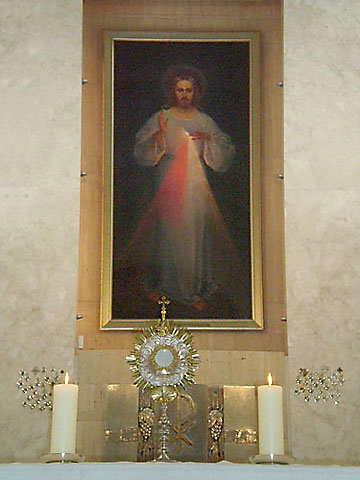
The painting of the Image (of Merciful Jesus) and the exposition of the Image for public honor, making the Chaplet to the Divine Mercy widely known, undertaking preliminary efforts to establish the Feast of the Divine Mercy and the founding of the new Congregation all took place in Vilnius thanks to Father Michael Sopocko. From that time the collaborative efforts, brought to fruition at the cost of prayer and suffering, now radiate to embrace the whole world.
Father Sopocko writes in his diary: "There are the truths which are known and often heard and spoken but not understandable. It was like that with me, concerning the truth of Divine Mercy. So many times I mentioned this truth in my sermons and thought about it during the retreats. I repeated it in church prayers - especially in Psalms - but I didn’t understand the meaning of this truth, and I didn’t get to the core of its essence, that it is the highest attribute of God’s external activity. It was only this simple nun, S. Faustina from the Congregation of the Sisters of Our Lady of Mercy (Magdalens), who, by telling me this truth in simple terms and often repeating it, stimulated me to examine, study and think about this truth.
(...) in the beginning I didn’t know what the problem was; I listened, distrusted, thought, studied and sought advice from others - but only several years after did I understand the greatness and importance of this work. Only then was i convinced about the effectiveness of this old, but hugely neglected life-giving devotion, and the neccesity for its renewal in or times. (...) Trust in God’s Mercy, and the spreading of devotion to His mercy among others will be the general principle of the rest of my life. With the help of His immeasurable mercy I will devote of all thoughts, words and deeds to it, without a shadow of myself".
Jesus to St. Faustina - "As a result of his efforts, "A new light will shine in the Church of God for the consolation of souls"
(Diary, 1390).
St. Faustina writes ..."I was talking with my spiritual director, I had an interior vision, of his soul in great suffering, in such agony that God touches very few souls with such fire. The suffering arises from this work. There will come a time when this work, which God is demanding so very much, will be as though utterly undone. And then God will act with great power, which will give evidence of its authenticity. It will be a new splendor for the Church, although it has been dormant in it from long ago. Diary 378
Fr. Sopocko would also found the new community that was requested by Jesus to St. Faustina now known as the Sisters of Merciful Jesus. On February 3, 1942, the first meeting of the six candidates of the newly founded congregation took place in Fr. Sopocko’s apartment. Similar meetings were few. Unfortunately on March 3, 1942, Germans organized a raid and arrested almost all the priests. Father Michael Sopocko was searched for by the Gestapo for helping Jews, but he escaped from Vilnius. He was able to get to the Ursulane sisters’ convent in Czarny Bor, 4 km away from Vilnius, where he spent 2 1/2 years working as a carpenter. He communicated with the six sisters through letters. Every now and then one of the six would visit him. Father Sopocko came back to Vilnius on August 19, 1944. In November, Faustina Osinska together with her friends, asked him to accept their vows. In connection with this on November 9, 1944, he started to give to the first six a retreat. This retreat was to be an immediate preparation for the ceremony of the vows, which were planned for November 16.

"After the retreat, at the appointed day, on early and dark morning, for the curfew was still obligatory, from different parts of the city, six girls came from the Zarzecze suburb, to the chapel of Carmelite Sisters’. There in a "catacomb" atmosphere after Holy Mass at five o’clock they took their simple private vows of loyal service to the Most Merciful Savior and His Merciful Mother. It is impossible to describe with words the joyful atmosphere that prevailed among the "newly vowed" of Christ. A simple meal was prepared at the convent gate by hospitable Sister Carmelites. How happy they were in spite of different kinds of lacking, they were so rich in spite of poverty showing itself from everywhere, they were brave and full of trust in spite of the dangers lying in wait from everywhere" (Michael Sopocko, memoirs).

"After the retreat, at the appointed day, on early and dark morning, for the curfew was still obligatory, from different parts of the city, six girls came from the Zarzecze suburb, to the chapel of Carmelite Sisters’. There in a "catacomb" atmosphere after Holy Mass at five o’clock they took their simple private vows of loyal service to the Most Merciful Savior and His Merciful Mother. It is impossible to describe with words the joyful atmosphere that prevailed among the "newly vowed" of Christ. A simple meal was prepared at the convent gate by hospitable Sister Carmelites. How happy they were in spite of different kinds of lacking, they were so rich in spite of poverty showing itself from everywhere, they were brave and full of trust in spite of the dangers lying in wait from everywhere" (Michael Sopocko, memoirs).
Fr. Sopocko also wrote "I congratulate you, dear Sisters. This is a special grace of Divine Mercy that has revealed itself in your vocation. Chosen ones of the Sacred Heart of Jesus, pillars of the future convent, confidantes of God’s mysteries, most desired and prayed for, for the past five years in each daily Holy Mass" (Letter to the Sisters from Czarny Bor).
Referenced from: http://www.faustina-message.com/
Bl. Fr. Michael Sopocko died on 15th February 1975 in Poleska Street in Bialystok. And 33 years later, Fr. Sopocko was proclaimed Blessed by the Church and was beatified in Bialystok on 28th September 2008.
Words from Bl. Michael Sopocko..
Priest and Servant of Jesus Divine Mercy
The motto ‘Jesus, I trust you!’ warms up what was cold, softens what was hard, revives what was withered, lights what was going out and instead of hatred that divides all people today it unites individuals, families, societies, nations and countries with an embrace of real brotherly love of God and neighbour."
"The message of the Gospel does not depend on proclaiming that sinners should become good, but rather that God is good for sinners"
The Brothers of Merciful Jesus
The Community of The Brothers of Merciful Jesus was approved by Cardinal J.A. Bačkis of Vilnius, Lithuania, on July 11, 2005. These brothers took the responsibility both personally and through community to respond to a “charism” of living and proclaiming God’s mercy as it was revealed to Saint Faustina and continued by her spiritual father, a servant of God, Blessed Father Michael Sopočko. Blessed Father Sopočko, an Apostle of Mercy, played an important role in deepening and spreading the spirituality of Jesus the Merciful. Blessed Father Sopočko was beatified in Bialystok, Poland on September 28, 2008.
http://www.faustina-message.com/
Subscribe to:
Posts (Atom)