Showing posts with label France. Show all posts

Massive One Million Rally against Gay Marriage in Paris


An estimated one million people took to the streets of Paris on Sunday to demonstrate against France's new same-sex marriage legislation. The law, which allows same-sex partners to wed and adopt, had already been in effect for over a week. President François Hollande signed it into law on May 18.


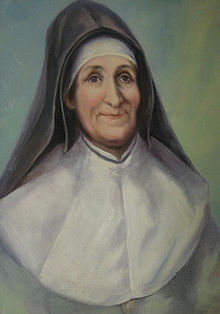
St. Théodore Guérin - France

Foundress of Sisters of Providence of Saint Mary-of-the-Woods

“What strength the soul draws from prayer! In the midst of a storm, how sweet is the calm it finds in the heart of Jesus. But what comfort is there for those who do not pray?” These words, written by Mother Théodore Guérin after surviving a violent storm at sea, perhaps best exemplify her life and ministry. Truly, Mother Theodore drew strength from prayer, from conversations with God, with Jesus and with the Blessed Virgin Mary. Throughout her life, she encouraged prayer as she sought to share the love of God with people everywhere.

Mother THÉODORE—ANNE-THÉRÈSE GUÉRIN—was born Oct. 2, 1798, in the village of Etables, France. Her devotion to God and to the Roman Catholic Church began when she was a young child. She was allowed to receive her First Communion at the age of 10 and, at that time, told the parish priest that someday she would be a nun.

The child Anne-Thérèse often sought solitude along the rocky shore near her home, where she devoted hours to meditation, reflection and prayer. She was educated by her mother, Isabelle Guérin, who centered lessons on religion and Scripture, thus nurturing the child’s love of God. Anne-Thérèse’s father, Laurent, who served in Napoleon’s navy, was away from home for years at a time. When Anne-Thérèse was 15 years old, her father was murdered by bandits as he traveled home to visit his family. The loss of her husband nearly overwhelmed Isabelle and, for many years, Anne-Thérèse bore the responsibility of caring for her mother and her young sister, as well as the family’s home and garden.

Through those years of hardship and sacrifice, indeed through all the years of her life, Mother Théodore’s faith in God neither wavered nor faltered. She knew in the depths of her soul that God was with her and always would be with her, a constant companion.

Anne-Thérèse was nearly 25 years old when she entered the Sisters of Providence of Ruillé-sur-Loir, a young community of women religious serving God by providing opportunities for education to children and by caring for the poor, sick and dying.  While teaching and caring for the sick in France, Mother Théodore, then known as Sister St. Theodore, was asked to lead a small missionary band of Sisters of Providence to the United States of America, to establish a motherhouse, to open schools and to share the love of God with pioneers in the Diocese of Vincennes in the State of Indiana. Humble and prone to feelings of unworthiness, Mother Theodore could not imagine that she was suitable for such a mission. Her health was fragile. During her novitiate with the Sisters of Providence, she became very ill. Remedies cured the illness but severely damaged her digestive system; for the remainder of her life she was able to consume only soft, bland foods and liquids. Her physical condition added to her doubts about accepting the mission. Nevertheless, after hours of prayer and lengthy consultations with her superiors, she accepted the mission, fearing that if she did not, no one would venture to the wilderness to share the love of God.

Equipped with little more than her steadfast desire to serve God, Mother Théodore and her five companion Sisters of Providence arrived at the site of their mission at Saint Mary-of-the-Woods, Indiana, the evening of October 22, 1840, and immediately hastened along a muddy, narrow path to the tiny log cabin that served as the chapel. There, they knelt in prayer before the Blessed Sacrament to thank God for their safe journey and to ask for God’s blessings for the new mission.

Here, on this hilly, ravine-cut, densely forested land, Mother Théodore would establish a motherhouse, a school and a legacy of love, mercy and justice that continues to this day. 
Throughout years of sorrow and years of peace, Mother Théodore relied upon God’s Providence and her own ingenuity and faith for counsel and guidance. She urged Sisters of Providence to “Put yourself gently into the hands of Providence.” In letters to France, she stated, “But our hope is in the Providence of God, which has protected us until the present, and which will provide, somehow, for our future needs.”

In the fall of 1840, the mission at Saint Mary-of-the-Woods consisted only of a tiny log cabin chapel that also served as lodging for a priest, and a small frame farmhouse, where Mother Théodore, the sisters from France and several postulants lived. During that first winter, harsh winds blew from the north to rattle the little farmhouse The sisters were often cold and frequently hungry. But they transformed a porch into a chapel and were comforted by the presence of the Blessed Sacrament in the humble motherhouse. Mother Théodore said, “With Jesus, what shall we have to fear?”

During the early years at Saint Mary-of-the-Woods, Mother Théodore encountered numerous trials: prejudice against Catholics and, especially, against Catholic women religious; betrayals; misunderstandings; the separation of the Congregation in Indiana from the one in Ruillé; a devastating fire that destroyed an entire harvest leaving the sisters destitute and hungry, and frequent life-threatening illnesses. Still she persevered, desiring only that “In all and everywhere may the will of God be done.” In correspondence to friends, Mother Théodore acknowledged the tribulations. She wrote: “If ever this poor little Community becomes settled, it will be established on the Cross; and that is what gives me confidence and makes me hope, sometimes even against hope.”

Less than a year after arriving at Saint Mary-of-the-Woods, Mother Théodore opened the Congregation’s first Academy and, in 1842, established schools at Jasper, Indiana, and St. Francisville, Illinois By the time of her death on May 14, 1856, Mother Théodore had opened schools in towns throughout Indiana, and the Congregation of the Sisters of Providence was strong, viable and respected. Always, Mother Théodore attributed the growth and success of the Sisters of Providence to God and to Mary, the Mother of Jesus, to whom she dedicated the ministry at Saint Mary-of-the- Woods.

Mother Théodore’s holiness was evident to people who knew her, and many described her simply as “saintly”. She possessed the ability to draw out the best in people, to enable them to attain more than they thought possible. Mother Théodore’s love was one of her great hallmarks. She loved God, God’s people, the Sisters of Providence, the Roman Catholic Church and the people she served. She did not exclude anyone from her ministries or her prayers, for she dedicated her life to helping people know God and live better lives.

Mother Théodore knew that alone she could do nothing, but that all things were possible with God. She accepted trials, trouble and occasions when she was treated unjustly as part of her life. In the midst of persecution, Mother Théodore remained true, a faithful woman of God.

Mother Théodore died sixteen years after she arrived at Saint Mary-of-the-Woods. During those fleeting years, she touched a countless number of lives—and continues to do so today.
The gift she gives to each succeeding generation is her life as a model of holiness, virtue, love and faith.

She was beatified by Pope John Paul II in October 1998 and finally canonized a saint of the Roman Catholic church on October 15, 2006, by Pope Benedict XVI.


St. Michael Garicoits - France

Founder of The Society of Priests of the Sacred Heart of Betharram

Saint Michael Garicoits was born in 1797 on a small farm in the south of France, near the town of Ibarre, not far from Lourdes and from Betharram, an ancient pilgrimage site. Later the mother house of the Congregation which he founded, the Priests of the Sacred Heart of Betharram, was established at that site.


He was ordained a priest at Bayonne in 1823, and spent two years as Assistant in the parish of Cambo, where he established the devotion and confraternity of the Sacred Heart. He was summoned to the Major Seminary of Betharram to serve as a professor of philosophy and theology in 1825, and he became Superior there in 1831.

In 1832 he made a retreat based on the Spiritual Exercises of Saint Ignatius, which strengthened in him his desire to found a new Society of Priests, a desire confirmed by his superiors’ approbation. He had been greatly impressed by the poverty he had seen practiced by a holy Foundress of a Congregation of Sisters, herself compared to Saint Teresa of Avila, who during her lifetime saw 99 houses of her Congregation established in several countries. Saint Michael desired the same practice of poverty for his priests, as he had seen instituted under the direction of Saint Elizabeth Bichier des Ages, who founded the Daughters of the Cross, or Sisters of Saint Andrew. Saint Elizabeth was, by a singular disposition of Providence, later canonized the same day as Saint Michael. Both Saints taught the importance of the interior life as the unique and irreplaceable source of any serious apostolate.

In his early efforts as founder, the fervent priest was faced with the opposition of his bishop, who desired that the new Institute be placed more specifically under diocesan authority than under that of its religious Superiors. Saint Michael, devoted to the Will of God, the point of departure to attain sanctity, remained in submission for long years. In 1875, after a wholly supernatural intervention which occurred in the nearby Convent of Pau through the intermediary of the Arab Carmelite, Blessed Mary of Jesus Crucified, the Institute as he conceived it was approved in Rome under Leo XIII. This occurred after the holy Founder had already been called to his reward in 1863.

Miracles by the dozens had followed his death, and the Priests of the Sacred Heart of Betharram spread in the lands of South America, as well as in France, England and Italy, where they direct teaching activities.

At the canonization, Pius XII exhorted the religious of the Institute of the Sacred Heart and the Daughters of the Cross, present at the canonization of their respective Founders, to maintain the primitive spirit of their Congregations, saying: “Be deaf to the temptation to sacrifice your religious life and personal sanctification to the apostolate. That would be similar to gathering beautiful flowers from a tree to form a bouquet, and afterwards wanting to find fruit on barren branches.” 

He was canonized in the year 1947. His feast day is May 14th.


Bl. Fr. Basil Anthony Mary Moreau - France

Founder of the Congregation of the Holy Cross &
the Marianites of the Holy Cross

Basil Anthony Mary Moreau, the ninth of 14 children, was born during the French Revolution on 11 February 1799 in Laigné-en-Belin, Sarthe, France, to a poor but pious family. In 1814 he entered St Vincent's Major Seminary in Le Mans run by the Sulpician Order, which greatly influenced his spirituality.


On 12 August 1821 he was ordained a priest at age 22. An exception was made for this early ordination to compensate for the large number of priests killed during the French Revolution. In 1823 he became professor of philosophy at the minor seminary of Tessé. Then in 1825 he taught at St Vincent Seminary and later became the vice-rector and spiritual director.

Much of Fr Moreau's work aimed to repair the damage done by the French Revolution, first by giving the seminarians a solid formation, and second by preaching popular missions to the faithful. Recognizing the laity's pastoral needs, Fr Basil organized the Auxiliary Priests of Le Mans in 1833 to assist diocesan clergy with their heavy pastoral burdens.

In 1835 Bishop Jean-Baptiste Bouvier asked Fr Moreau to assist the Congregation of the Brothers of St Joseph (established in 1820 at Ruillé-sur-Loir), whose Founder, Canon Jacques-François Dujarié, was no longer able to direct the Order due to illness. 
After attempting to govern the communities separately, Fr Moreau united the Congregation of the Brothers of St Joseph and the Society of Auxiliary Priests of Le Mans into one religious institute, which became the Congregation of Holy Cross on 1 March 1837 with a "Fundamental Pact of Union".

On 15 August 1840 Fr Moreau pronounced his perpetual vows in the presence of Bishop Bouvier, and was followed by several of his first associates. His relationship with Bishop Bouvier was often tried by differing viewpoints on how best to revitalize the faith and administer the Congregation following the Revolution.
Fr Moreau's allegiance to Rome did not allow him to share the Gallican sympathies of the local Ordinary. Therefore, when it would have been possible for the Congregation of Holy Cross to apply for Pontifical approval, thus significantly reducing Bishop Bouvier's authority over the Order, it did not receive his needed support.

This was an opportunity for Fr Moreau to practice the Congregation's special vow of obedience and respect to the hierarchy. In fact, Pontifical approval was granted only after Bishop Bouvier's death in 1854. In 1841 Fr Moreau founded the Marianites of Holy Cross to be housekeepers in the schools staffed by Holy Cross priests and Brothers, but the Sisters' activity soon expanded to include other apostolates and missionary work.

Although Fr Moreau wanted to include the Marianite Sisters in the Holy Cross Congregation, the Holy See excluded them from the definitive Decree of approval that was granted on 13 May 1857.  Instead, they were to be governed separately. Nonetheless, the two institutes carried out much of their apostolic activities as a united effort.

Another trial came with the expansion of the Order at a time when poor means of communication left room for individualistic governance by the communities located far from France.  Such was the case with the community founded in 1842 in Indiana, U.S.A., by Fr Edward F. Sorin. The local Bishop, grateful for apostolic assistance in his huge Diocese, entrusted Fr Sorin with an Indian mission and broad jurisdiction. The priest rushed into building projects without the necessary approval and sent the bills to the Motherhouse in France.

In fact, Fr Moreau's forbearance with his confrere, Fr Sorin, brought the unforeseen fruit of the Order's first university in the U.S.A.: Notre Dame University.  Fr Moreau suffered much due to the internal strife that developed within the male and female branches, especially with those in the U.S.A. This eventually led to the U.S.A. Sisters breaking with their French origins and associating with Fr Sorin.

Fr Basil spent his last years in a house owned by the Marianite Sisters, who continued to provide for his daily meals and needs. During this time he preached retreats and missions and substituted for parish priests. While replacing a priest at Yvre l'Eveque in December 1872, Fr Moreau became ill, and after his return to Le Mans, he died on 20 January 1873 at age 73.

In 1955 his cause for Beatification was introduced and on 12 April 2003 Pope John Paul II proclaimed him Venerable.  Father Moreau was beatified on September 15, 2007 in Le Mans, France

St. Andrew Fournet - France

Co Founder of the Daughters of the Cross

St. Andrew Fournet was born on December 6, 1752. He was from Maille, a little town near Poitiers, in France. Andrew's parents were religious people. Mrs. Fournet had her heart set on Andrew becoming a priest. The little boy heard this more often than he cared to. Once he declared, "I'm a good boy, but I'm still not going to be a priest or monk."


When he grew up, he went to Poitiers to study college subjects. But that did not last long. He was having too good of a time. His mother followed him and steered him to good occupations. But they fell through, one after another. His mother was frantic. There was only one more possibility. She talked Andrew into going to stay for a while with his uncle, a priest. His uncle's parish was poor and his uncle was a holy man. For some unpredictable reason, Andrew agreed. This was God's "teachable moment."

Andrew's uncle recognized his nephew's good qualities. His own example sparked something in Andrew and he settled down. He began to study seriously and to make up for lost time. He was ordained a priest and was assigned to his uncle's parish. In 1781, he was transferred to his home parish in Maille. His mother was jubilant. He had become a caring, prayerful priest.

When the French Revolution began, St. Andrew refused to take an oath that was against the Church. He became a hunted man. In 1792, he was forced to flee to Spain. There he remained for five years. But he worried about his people and went back to France. The danger was as great as before. Father Fournet was protected by his flock. He nearly escaped death several times. Meanwhile, he heard confessions, celebrated the Eucharist, gave the Last Rites.

When the Church was free again, St. Andrew came out of hiding. He was always inviting his people to love and serve God. One of the good ladies from the area, St. Elizabeth Bichier des Ages, helped St. Andrew very much. Together they started an order of sisters called the Daughters of the Cross. St. Elizabeth's feast day is August 26.

St. Andrew died on May 13, 1834, at the age of eighty-two. He was proclaimed a saint by Pope Pius XI on June 4, 1933.

Reflection: Let us always ask God to fulfill the good work he has begun in us that we might live freely and completely.

St. Julie Billiart - France

Foundress of the Congregation of the Sisters of Notre Dame de Namur

St. Julie (Julia) Billiart was born in 1751 and died in 1816. As a child, playing "school" was Julie's favorite game. When she was sixteen, to help support her family, she began to teach "for real". She sat on a haystack during the noon recess and told the biblical parables to the workers. Julie carried on this mission of teaching throughout her life, and the Congregation she founded continues her work.


Julie was the fifth of seven children. She attended a little one room school in Cuvilly. She enjoyed all of her studies, but she was particularly attracted to the religion lessons taught by the parish priest. Recognizing something "special" in Julie, the priest secretly allowed her to make her First Communion at the age of nine, when the normal age at that time, was thirteen. She learned to make short mental prayers and to develop a great love for Jesus in the Eucharist.

A murder attempt on her father shocked her nervous system badly. A period of extremely poor heath for Julie began, and was to last for thirty years. For twenty-two of these years she was completely paralyzed. All of her sufferings and pain she offered up to God.

When the French Revolution broke out, Julie offered her home as a hiding place for loyal priests. Because of this, Julie became a hunted prey. Five times in three years she was forced to flee in secret to avoid compromising her friends who were hiding her.

At this time she was privileged to receive a vision. She saw her crucified Lord surrounded by a large group of religious women dressed in a habit she had never seen before. An inner voice told her that these would be her daughters and that she would begin an institute for the Christian education of young girls. She and a rich young woman founded the Sisters of Notre Dame de Namur.

At Amiens, the two women and a few companions began living a religious life in 1803. In 1804, Julie was miraculously cured of her illness and walked for the first time in twenty-two years. In 1805, Julie and three companions made their profession and took their final vows. She was elected as Mother General of the young Congregation.

In 1815, Mother taxed her ever poor health by nursing the wounded and feeding the starving left from the battle of Waterloo. For the last three months of her life, she again suffered much. She died peacefully on April 8, 1816 at 64 years of age. Julie was beatified on May 13, 1906, and was canonized by Pope Paul VI in 1969. Her feast day is April 8th.

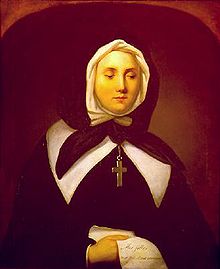
St. Marguerite Bourgeoys

Foundress of the Congregation of Notre Dame.

Marguerite Bourgeoys was born the sixth of twelve children of devout parents. After her mother died, Marguerite at 19 took care of her brothers and sisters. Her father, a candle maker, died when she was twenty-seven. A few years later, the governor of Montreal, Canada, Paul Chomedey de Maisonneuve was in France looking for teachers for the New World. He invited Marguerite to come to Montreal to teach school and religion classes. She accepted the offer.

Marguerite Bourgeoys gave away her share of the inheritance from her parents to other members of the family. In 1653, she sailed for New France. On arriving, she initiated the construction of the Notre-Dame-de-Bon-Secours Chapel in honour of Our Lady of Perpetual Help. She opened her first school in 1658 and she first worked with rich children, but soon started working with poor and rich people. She returned to France the next year to recruit more teachers, convincing four to accompany her. In 1670, she went to France again, and brought back six more women. Having braved dangerous travel and pioneer conditions, these women became the first Sisters of the Congregation of Notre Dame.

Bourgeoys and her sisters helped people in the colony survive when food was scarce, opened a vocational school, taught young people how to run a home and farm. Bourgeoys' congregation grew to 18 sisters, seven of them Canadian. They opened missions, and two sisters taught at the Native American school. Soon after, Bourgeoys received the first two Native American women into the congregation.

In 1693, Mother Marguerite handed over her congregation to her successor, Marie Barbier, the first Canadian to join the order. The congregation's religious rule was approved by the Church in 1698.

Marguerite spent her last few years praying and writing an autobiography. On December 31, 1699, as a young sister lay dying, Mother Marguerite asked God to take her life in exchange. By the next morning of January 1, 1700, the sister was completely well. But, Mother Marguerite had a raging fever, suffered 12 days, and died on January 12, 1700.[citation needed]

Legacy and Canonisation
Marguerite Bourgeoys was declared venerable in 1878, beatified on 12 November 1950, and canonised by John Paul II on 31 October 1982. She is commemorated in both the Catholic Church and in the Anglican Church of Canada on January 12.

She was buried in the sanctuary of Notre-Dame-de-Bon-Secours Chapel in Montreal. The church now includes a museum about her life and the early history of Montreal. A Quebec provincial electoral district in Montreal is named after Bourgeoys.